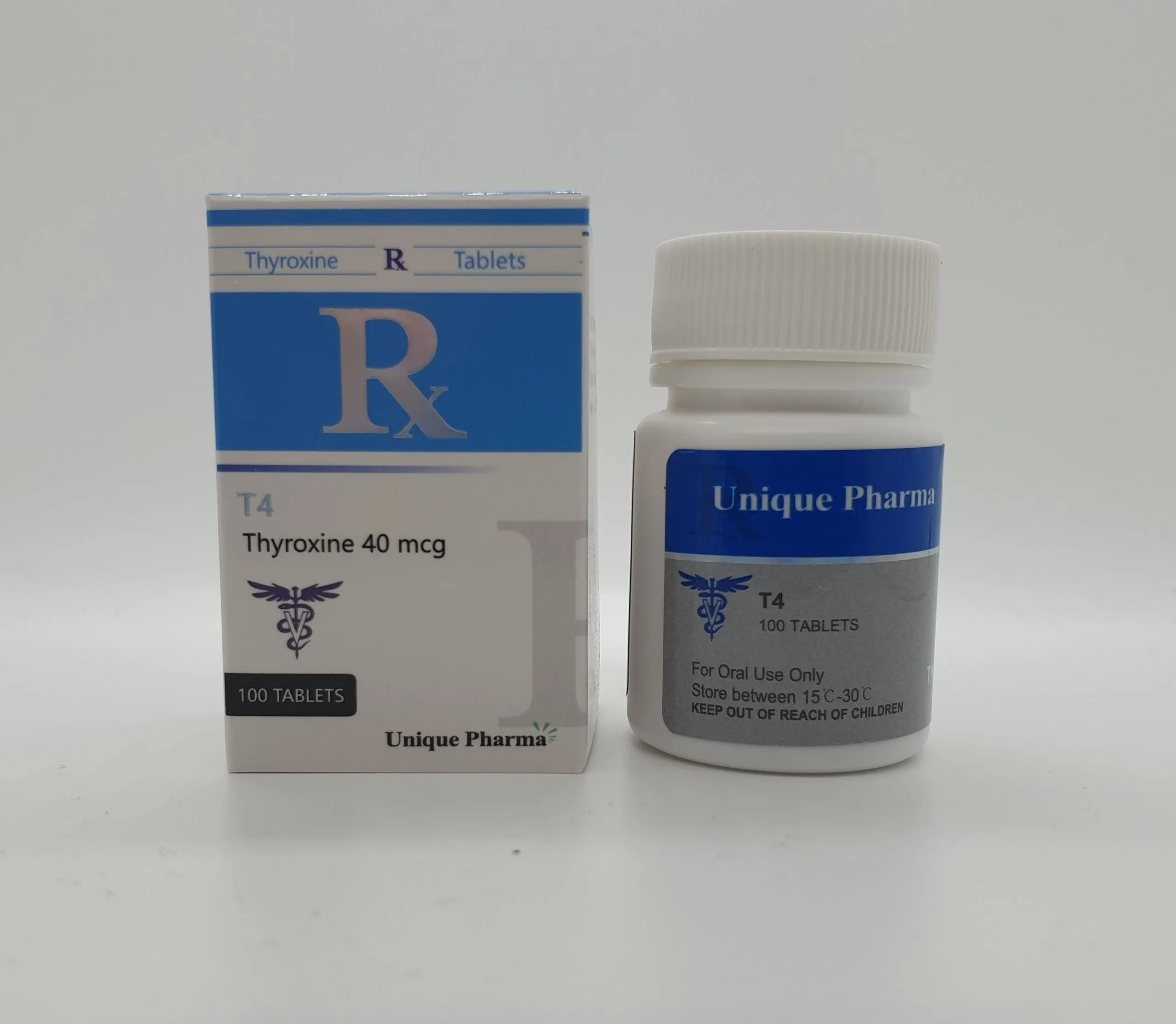
T4 Thyroid 40 mcg/tab
€ 45,00
Auf LagerBuy premium T4 Thyroid (Levothyroxine) from Unique Pharma. Lab-tested, fast shipping, competitive prices. For metabolic support.
Akne
Yes
Halbwertszeit
9-12 Hours
Dosierung
20-40mg Daily
Nachweiszeit
5 Days
Aromatisierung
N/A
Wasserretention
No
Hepatotoxizität
N/A
HBR
N/A
Produktinformation
Über T4 Thyroid 40 mcg/tab
1. Description: Clinical summary
T4 (active compound: t4-thyroid) refers to levothyroxine sodium, the synthetic form of thyroxine (T4), the principal hormone normally produced by the thyroid gland. It is used to replace or supplement endogenous thyroid hormone in patients with hypothyroidism (congenital or acquired), to suppress thyroid-stimulating hormone (TSH) in certain forms of nodular thyroid disease or differentiated thyroid cancer, and as part of emergency treatment for severe hypothyroidism (myxedema coma) when administered intravenously.
Key clinical points
- Primary indications: primary hypothyroidism, subclinical hypothyroidism (selected cases), thyroidectomy or radioactive iodine replacement therapy, suppression therapy after thyroid cancer, congenital hypothyroidism (neonates/infants).
- Formulations: oral tablets (multiple strengths), oral liquid solutions/suspensions, and parenteral formulations (injectable levothyroxine) for inpatient or emergency use.
- Pharmacokinetics overview: after oral dosing, levothyroxine is absorbed primarily in the small intestine (variable bioavailability). T4 is a prohormone converted peripherally to the active hormone T3 by deiodinases. T4 has a long half-life (about 6–9 days in euthyroid adults), allowing once-daily dosing for replacement therapy.
2. How does t4-thyroid work?: Mechanism of action
- Levothyroxine is synthetic L-thyroxine (T4). It provides circulating T4 that enters cells and is deiodinated to triiodothyronine (T3), the more active form.
- T3 binds nuclear thyroid hormone receptors (TRα, TRβ) and regulates transcription of genes involved in metabolism, growth, thermogenesis, cardiac function, and many other physiologic processes.
- Replacement restores normal metabolic rate, protein synthesis, and sensitivity to catecholamines; suppression therapy reduces TSH-driven stimulation of thyroid tissue.
Physiologic consequences
- Increases basal metabolic rate, oxygen consumption, and heat production.
- Enhances carbohydrate and lipid metabolism.
- Increases heart rate, myocardial contractility, and cardiac output (effects important in dose selection for cardiac patients).
3. Dosage: Medical and varying usage guidelines
General principles
- Dose individualized by age, weight, comorbidities (especially cardiovascular disease), pregnancy status, and cause of hypothyroidism.
- Monitor response principally by serum TSH for primary hypothyroidism; use free T4 (fT4) for central (secondary/tertiary) hypothyroidism.
- Reassess TSH/fT4 6–8 weeks after initiation or any dose change (steady state reached in ~6 weeks), then periodically once stable.
Typical dosing guidelines (examples; adjust per clinical context)
Adults—replacement therapy (healthy, younger adults)
- Full replacement: approximately 1.6 mcg/kg/day (micrograms per kilogram per day).
- Typical daily dose for many adults: ~100–150 mcg/day depending on weight.
Elderly or patients with coronary artery disease
- Start low and go slow to avoid cardiac ischemia or arrhythmia.
- Initial: 12.5–25 mcg/day; titrate every 4–6 weeks based on TSH and symptoms.
- Some fit elderly patients may tolerate intermediate starting doses (e.g., 25–50 mcg/day).
Patients with hypothyroidism after thyroidectomy or radioactive iodine ablation
- Many require full replacement (approximately 1.6 mcg/kg/day), but adjust individually.
- If suppression of TSH is desired (e.g., thyroid cancer follow-up), doses are higher and guided by oncology/endocrinology goals and risk of adverse effects.
Pregnancy
- Increased thyroid hormone requirements during pregnancy.
- When hypothyroidism is identified or a woman becomes pregnant while on levothyroxine, empirically increase the dose by ~20–30% (e.g., two additional weekly doses or increase daily dose and recheck TSH within 4 weeks). Monitor TSH each trimester and adjust.
- Aim to maintain TSH within pregnancy-specific ranges (e.g., first trimester TSH <2.5 mIU/L; ranges vary by laboratory).
Pediatrics
- Neonates with congenital hypothyroidism: start 10–15 mcg/kg/day (often total 25–50 mcg/day initially for neonates; exact dose weight-based).
- Infants and children: dose per kg decreases with age (e.g., 3–4 mcg/kg/day in older infants/young children; adjust by age and growth).
- Rapid normalization of thyroid status is important for neurodevelopment; treat promptly and monitor frequently.
Myxedema coma / severe hypothyroidism (emergency)
- Typical approach (institutional practice varies): intravenous levothyroxine 200–400 mcg bolus followed by 50–100 mcg IV daily, or administer IV dose approximating 75% of the prior oral dose; often combined with stress-dose glucocorticoids until adrenal insufficiency excluded. Consider adding liothyronine (T3) in selected, closely monitored cases (higher arrhythmia risk).
Conversion oral ↔ intravenous
- Oral bioavailability is variable (commonly ~70–80%); when converting to IV, many clinicians use ~75% of the oral daily dose as an initial IV dose (e.g., oral 100 mcg → IV ~75 mcg), but follow product-specific guidance and clinical judgment. For myxedema, higher IV loading doses are used as above.
Switching products and bioequivalence
- Small potency differences between manufacturers and formulations can alter TSH. When possible, keep patients on the same product; if changed, check TSH 6–8 weeks after the switch.
Administration instructions
- Take on an empty stomach: 30–60 minutes before breakfast OR at bedtime (~3 hours after last meal).
- Separate from mineral supplements (calcium, iron), antacids, sucralfate, bile acid sequestrants, and some oral medications by at least 4 hours to avoid reduced absorption.
- If using liquid or suspension formulations, follow product-specific handling and dosing instructions.
Drug interactions that commonly affect dosing or monitoring
- Reduced absorption: calcium, iron, aluminum-containing antacids, sucralfate, bile acid sequestrants (cholestyramine, colestipol), sevelamer, lanthanum, oral phosphate binders, some high-fiber diets, soy formula.
- Increased clearance or reduced T4 levels: rifampin, carbamazepine, phenytoin, phenobarbital, sertraline (some reports), other hepatic enzyme inducers.
- Altered thyroid hormone action/metabolism: amiodarone, lithium, high-dose iodine, interferon.
- Protein binding: estrogens (including pregnancy) increase thyroid-binding globulin → may increase total T4 and require higher levothyroxine dose to maintain free hormone levels.
- Antagonistic/monitoring interactions: levothyroxine can potentiate effects of warfarin (monitor INR) and catecholamines.
Special situations
- Central hypothyroidism (pituitary/hypothalamic disease): adjust dose to normalize free T4 in the mid-normal range rather than target TSH (TSH may be low/normal or unreliable).
- Cardiovascular disease: correct hypothyroidism cautiously; preexisting ischemic heart disease may require low starting doses and slow titration.
- Adrenal insufficiency: screen/consider empiric glucocorticoid coverage before starting levothyroxine when secondary adrenal insufficiency is possible; initiating thyroid hormone in an untreated adrenal-deficient patient can precipitate adrenal crisis.
Monitoring
- TSH (primary for primary hypothyroidism): 6–8 weeks after start or dose change, then every 4–6 months until stable, then annually or as clinically indicated.
- Free T4 for central hypothyroidism and when TSH is unreliable.
- In elderly or cardiac patients, monitor symptoms, heart rate, arrhythmias, and for signs of ischemia.
- During pregnancy: TSH every 4 weeks until stable, then each trimester.
4. Side effects: Common and rare bad effects
Side effects are predominantly those of thyroid hormone excess (overtreatment); true allergic reactions to levothyroxine are rare and often related to excipients.
Common adverse effects (usually due to excessive dosing / iatrogenic hyperthyroidism)
- Palpitations, tachycardia, increased pulse pressure.
- Nervousness, anxiety, tremor, insomnia.
- Weight loss, increased appetite.
- Heat intolerance, excessive sweating.
- Gastrointestinal upset (e.g., diarrhea).
Important serious and rare adverse effects
- Cardiac: angina exacerbation, arrhythmias (atrial fibrillation), myocardial ischemia/infarction (especially in patients with underlying coronary artery disease).
- Bone: accelerated bone loss and increased fracture risk with long-term overtreatment (especially postmenopausal women).
- Thyrotoxicosis: symptomatic hyperthyroidism from overdose or inadvertent over-replacement; severe thyrotoxicosis can be life-threatening.
- Allergic or hypersensitivity reactions to formulation excipients: rash, urticaria, pruritus (rare).
- Myocardial infarction or acute coronary events in high-risk cardiac patients if replacement is started too aggressively.
- In patients with adrenal insufficiency unmasked by levothyroxine, adrenal crisis can occur if glucocorticoid deficiency is not addressed.
Overdose management
- Acute large overdose (single ingestion): gastrointestinal decontamination (activated charcoal) may be considered if recent; symptomatic and supportive care. Beta-blockers (e.g., propranolol) are mainstay for symptomatic control of tachycardia and adrenergic symptoms. Cardiac monitoring and treatment for arrhythmias as needed. Endocrinology/toxicology consultation for severe cases.
- Chronic excess (iatrogenic): reduce dose or stop temporarily; monitor and treat complications (e.g., bisphosphonates for osteoporosis when indicated).
Contraindications and precautions
- Untreated thyrotoxicosis (do not give); unstable cardiac disease (initiate with caution).
- Relative contraindication in uncontrolled adrenal insufficiency until glucocorticoid replacement initiated.
- Use caution in elderly, those with ischemic heart disease, arrhythmias, hypertension, osteoporosis risk.
5. Storage: HOW to store it
General storage recommendations for oral levothyroxine (tablets)
- Store at controlled room temperature, typically 15–30°C (59–86°F); check the product label for manufacturer-specific conditions.
- Protect from moisture, heat, and light. Keep in the original blister pack or tight container with desiccant when provided.
- Avoid storing in bathrooms or other damp locations. Do not refrigerate tablets unless specified by manufacturer.
- Keep out of reach of children and pets.
Liquid/oral solution formulations
- Follow manufacturer instructions. Some liquid preparations may require storage at room temperature; others may specify refrigeration after opening—see the product leaflet.
- Note expiration dating after opening; discard per labeling.
Injectable formulations (parenteral levothyroxine)
- Follow the manufacturer’s label for storage temperature (some vials require refrigeration, others room temperature).
- Reconstitute and use according to product instructions; many parenteral products have specific time windows for use after reconstitution and specific storage requirements for prepared solutions.
- Hospital pharmacies should follow institutional protocols and manufacturer guidance for storage, handling, and disposal.
Disposal
- Dispose of unused or expired medication per local regulations or pharmacy take-back programs. Avoid flushing medications unless instructed.
Final practical reminders
- Always follow the specific product labeling and institutional protocols for dosing, storage, and administration.
- Keep a consistent brand/formulation when possible; if changed, retest TSH/fT4 after 6–8 weeks.
- Educate patients to take levothyroxine on an empty stomach, to separate interacting supplements/medications by several hours, and to report palpitations, chest pain, marked weight changes, or new tremor/insomnia promptly.
This guide is informational and does not substitute for individualized medical advice. Dosing and clinical decisions should be tailored by a healthcare professional based on the patient’s history, comorbidities, laboratory values, and local product labeling.
Dosierung
Empfohlen
20-40mg Daily
Halbwertszeit
9-12 Hours
Vorteile
- Laborgetestet auf Reinheit
- Pharmazeutische Qualität garantiert
- Diskreter und sicherer Versand
- Ausgezeichneter Kundenservice
- Schnelle Lieferung in ganz Europa
Kostenloser Versand
Kostenloser Versand bei Bestellungen über 200€.
Liefergarantie
Kostenloser Neuversand, wenn Ihre Bestellung nicht ankommt.
Schnelle Lieferung
Versand innerhalb 24h. Lieferung 48-72h in NL & BE.
Bitcoin Zahlung
Zahlen Sie sicher und bleiben Sie völlig anonym mit Bitcoin.
Sicherer Checkout
Gesicherte SSL-Verbindung für alle Transaktionen.
Authentisch
Echtheitsprüfung für alle unsere Produkte.